
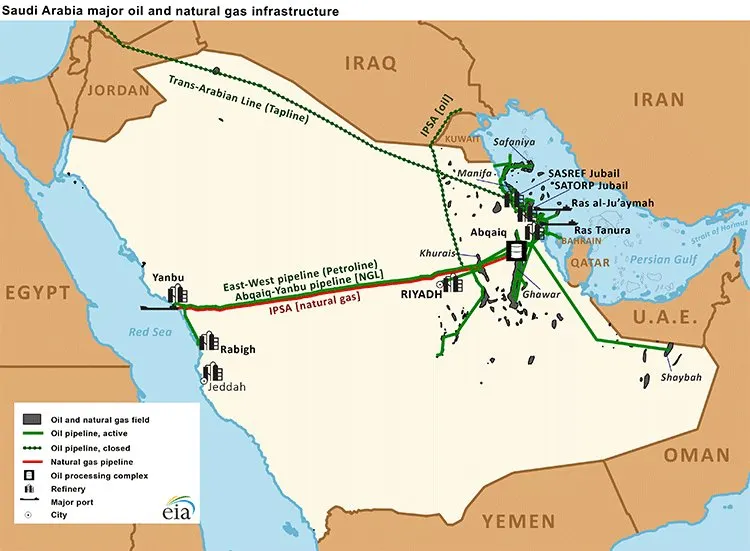
Saudi Arabia’s carefully constructed workaround for oil exports is hitting severe constraints on two fronts at once: kinetic threats from Yemen’s Houthis and commercial barriers from the London marine insurance market centered on Lloyd’s. The result is a growing bottleneck at the Red Sea that threatens a key remaining outlet for Saudi crude and products, with clear implications for global supply and prices.
The Red Sea Lifeline Under Pressure
Since the escalation of the Iran conflict earlier in 2026 disrupted the Strait of Hormuz, Saudi Arabia has leaned heavily on its East-West Pipeline (nameplate capacity around 7 million barrels per day) to move crude to the Yanbu terminal on the Red Sea. This has allowed exports to continue while reducing exposure to the Persian Gulf. A substantial share of Yanbu volumes supplies domestic western refineries and petrochemical plants; the rest moves out on VLCCs (typically ~2 million barrels each) and product tankers, with the bulk of crude destined for Asia.
That route is now compromised. On July 20, 2026, the Houthis declared a naval blockade targeting Saudi-linked shipping. They later claimed missile and drone strikes on the Saudi oil tankers Encelia and Layla in the Red Sea. The Bab el-Mandeb Strait—the southern exit from the Red Sea—has become effectively inaccessible for many Saudi-associated vessels. Chinese tankers carrying Saudi crude have sometimes passed with pauses, but Saudi-flagged, owned, or operated ships face elevated risk.
Even if vessels can physically sail, geography creates hard limits. Fully loaded VLCCs cannot transit the Suez Canal due to draft restrictions, so cargoes must use Egypt’s SUMED pipeline (effective throughput roughly 2.3–2.5 million bpd), which already has other commitments and faces congestion risks at loading and discharge points. Asia-bound volumes that cannot exit via Bab el-Mandeb face multi-week detours around the Cape of Good Hope, raising bunker costs, voyage times (from roughly three weeks to six or seven), and working capital needs while tightening overall tanker availability.
President Trump may want to offer insurance for Saudi Tankers to get US insurance companies moving and stop Lloyd’s of London’s squeeze. It might help persuade Saudi Arabia to join the Abraham Accords – Just saying.
The Insurance Squeeze from London
Compounding the Houthi pressure is a commercial one from the world’s primary marine insurance marketplace. According to a Financial Times report published around July 24, 2026, leading shipping insurers have told brokers they will not sell war cargo insurance to Saudi Arabia-linked ships in the Red Sea. Several major marine war insurers in the Lloyd’s of London market indicated they would exclude vessels with any “Saudi touchpoints” from coverage.
War-risk premiums had already risen sharply after the blockade announcement—indicative rates moving from around 0.3% of ship value to 0.75%, then above 1%, and in some cases as high as 3% for voyages involving southern Saudi Red Sea ports or Saudi-linked vessels closer to Yemeni territory. Even smaller increases translate into hundreds of thousands of dollars in extra cost per voyage. Without adequate war-risk and cargo cover, most commercial owners, charterers, lenders, and ports will not accept the vessels.
This is not a formal government ban; it is market-driven risk pricing and exclusion by underwriters assessing the Houthi threat. Lloyd’s Joint War Committee designations of high-risk areas amplify the effect, as vessels entering listed zones typically require additional premiums or face coverage gaps. The combination of physical threat and insurance withdrawal creates a powerful dual pressure.
Market Impacts If Tankers Cannot Be Insured
If Saudi-linked tankers cannot obtain (or cannot afford) insurance for Red Sea sailings, effective export capacity from Yanbu declines even if the physical infrastructure remains intact. Analysts have pointed to potential disruption of 3–4+ million barrels per day of Saudi crude and products that had been redirected to the Red Sea route—volumes that represent a meaningful share of global seaborne supply, especially after Hormuz constraints. Full closure of Bab el-Mandeb flows has been estimated to cut global oil supply by around 7% in some scenarios.
Immediate effects include:
- Higher freight and insurance costs for any remaining voyages or longer Cape routes.
- Delays of weeks for Asian refiners reliant on Yanbu barrels.
- Tighter tanker availability as longer voyages reduce effective fleet capacity.
- Faster pressure on refined-product markets (diesel, gasoline, jet fuel) than on crude, given thinner inventory buffers.
Oil prices have already reflected the risk. Brent crude climbed toward and briefly above $100 per barrel in the days after the Houthi claims, before easing somewhat (trading in the mid-to-high $90s range around July 24). Further sustained restrictions could push prices higher—some analysts have flagged potential moves above $115–$120 if flows are meaningfully disrupted—while adding inflationary pressure through elevated shipping and energy costs. European diesel refining margins had already surged to elevated levels amid earlier disruptions.
Workarounds exist but are imperfect: limited additional use of SUMED/Suez for non-Asia destinations, possible increased Gulf exports if Hormuz eases, strategic stock draws by importers, or Saudi self-insurance/state guarantees for a portion of cargoes. None fully replaces reliable commercial tanker access for large VLCC volumes to Asia.
How Saudi Arabia May Respond
Riyadh has condemned the Houthi actions as violations of international law and affirmed its right to protect vessels.
Options include:
- Enhanced naval protection or escorts for tankers (drawing on Saudi or coalition assets).
- Diplomatic pressure, potentially via regional or international channels, to de-escalate the blockade.
- Greater reliance on self-insurance, captive underwriting, or government-backed guarantees to keep some vessels moving.
- Maximizing alternative logistics where possible and prioritizing higher-value or shorter-haul cargoes.
- Longer-term acceleration of pipeline or terminal flexibility, though physical geography limits near-term options.
The broader context remains the Iran conflict and its spillover. Energy security increasingly hinges not only on production capacity but on the ability to move barrels safely and under commercial insurance terms. Saudi Arabia’s East-West/Yanbu strategy was designed precisely to reduce Hormuz vulnerability; the current dual roadblocks show how quickly secondary chokepoints and market mechanisms can reimpose constraints.
For global markets, the message is clear: logistical and insurance friction can tighten supply as effectively as production outages. Prices will remain sensitive to any further reduction in Saudi Red Sea loadings or confirmation that insurance exclusions are broadening. Watch tanker fixtures, war-risk premium quotes, Yanbu loadings data, and any official Saudi or insurer statements closely in the coming days.
Appendix: Sources and Links
- Cyril Widdershoven, “The Red Sea Is Becoming Saudi Arabia’s Biggest Oil Bottleneck,” OilPrice.com, July 24, 2026.
https://oilprice.com/Energy/Crude-Oil/The-Red-Sea-Is-Becoming-Saudi-Arabias-Biggest-Oil-Bottleneck.html - Financial Times, “Ship insurers restrict war coverage for Saudi Arabian cargoes in Red Sea,” July 24, 2026 (approx.).
https://www.ft.com/content/52aa89e9-f014-498e-8415-2c435a1c858d - Reuters, “Red Sea war insurance costs rise after Houthi blockade, sources say,” July 20, 2026.
https://www.reuters.com/legal/litigation/red-sea-war-insurance-costs-rise-after-houthi-blockade-sources-say-2026-07-20/ - Insurance Journal / related reporting, “War Risk Insurance Costs Surge for Southern Red Sea Voyages After Houthi Attacks,” July 23, 2026.
https://www.insurancejournal.com/news/international/2026/07/23/878788.htm - Reuters, “Houthi Red Sea blockade would lift oil prices, but workarounds could limit impact,” July 20, 2026.
https://www.reuters.com/business/energy/houthi-red-sea-blockade-would-lift-oil-prices-workarounds-could-limit-impact-2026-07-20/ - Al Jazeera, “Yemen’s Houthis claim attack on two Saudi oil tankers,” July 22, 2026.
https://www.aljazeera.com/news/2026/7/22/yemens-houthis-claim-attack-on-two-saudi-oil-tankers - Reuters, “Yemen’s Houthis declare naval blockade against Saudi Arabia,” July 20, 2026.
https://www.reuters.com/world/middle-east/yemens-houthis-declare-naval-blockade-against-saudi-arabia-statement-2026-07-20/ - OilPrice.com, “Houthi Red Sea Blockade Could Shatter Hopes for Lower Oil Prices,” July 22, 2026.
https://oilprice.com/Energy/Oil-Prices/Houthi-Red-Sea-Blockade-Could-Shatter-Hopes-for-Lower-Oil-Prices.html - Additional contemporaneous coverage from CNBC, New York Times, Washington Post, and maritime security assessments (Ambrey) on the tanker incidents, blockade, and price reactions (July 20–24, 2026).
Note: Market conditions and insurance terms can change rapidly; figures on premiums and loadings are based on reported indicative rates and analyst estimates as of late July 2026.
The post Saudi Arabia Is Running Into Oil Roadblocks—and How Will They Handle? appeared first on Energy News Beat.