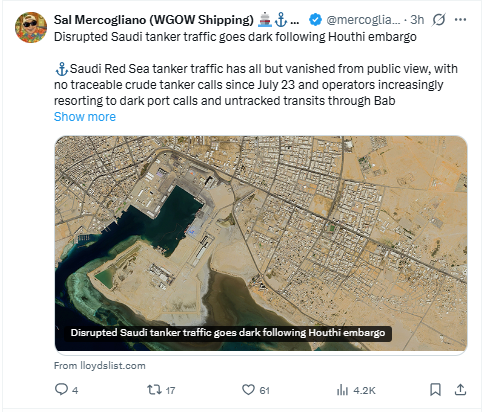


Tanker traffic through the Bab el-Mandeb Strait at the southern entrance to the Red Sea has slumped to a multi-month low, underscoring how Yemen’s Iran-aligned Houthi threats and recent attacks continue to disrupt one of the world’s most critical oil shipping lanes. According to vessel-tracking data, only 11 commodity-carrying vessels—including just seven oil tankers (four outbound and three inbound)—transited the strait on Sunday, marking a sharp drop that began after the Houthis announced a blockade targeting Saudi shipments and ports.
The slowdown comes amid a broader pattern of caution. Observable traffic at Saudi Arabia’s key Red Sea export hub of Yanbu has dwindled to near zero in recent days. As of early Tuesday, no tankers were visible at the terminal, with operators increasingly switching off Automatic Identification System (AIS) transponders to reduce the risk of becoming targets. This follows Houthi claims of attacks on Saudi tankers and related infrastructure last week, including reported strikes that prompted further diversions.
Saudi Aramco and other operators are adapting by shifting logistics northward. Crude is being shuttled by tanker from Yanbu to Egypt’s Ain Sukhna terminal on the Gulf of Suez, then moved via the SUMED onshore pipeline to the Mediterranean port of Sidi Kerir. At least eight very large crude carriers (VLCCs)—and more than half a dozen empty supertankers overall—are currently signaling Sidi Kerir as their destination, with arrivals expected over the next two to three weeks through mid-August. This allows loadings of Saudi crude without forcing vessels south through the high-risk Bab el-Mandeb.
Some vessels that had already loaded at Yanbu for Asian destinations have reversed course toward the Suez Canal rather than risk the southern Red Sea. At least one Asia-bound tanker carrying Saudi crude has taken the longer path through the Suez Canal, into the Mediterranean, and potentially onward around Africa via the Cape of Good Hope. Western and Saudi-linked operators are prioritizing the Suez route to bypass Bab el-Mandeb entirely where possible.
Impacts on Suez Canal and Broader Shipping
While precise daily Suez Canal tanker counts for late July remain fluid amid the rapid shifts, the waterway is seeing increased diversion traffic as an alternative to the southern Red Sea. Tankers and some cargo vessels are using Suez to avoid Houthi-controlled waters near Yemen. Overall commercial shipping through the Red Sea and its approaches has faced scattered U-turns, holding patterns, and reduced volumes, with effects extending beyond oil tankers to product carriers and general cargo. Hormuz traffic, already under pressure from regional tensions, remains near two-month lows, compounding the strain on Middle East crude flows.
Time and Cost Penalties of Rerouting
Avoiding the Red Sea/Bab el-Mandeb corridor adds substantial time and expense. A typical VLCC voyage from a Saudi Red Sea loading (or via Sidi Kerir/SUMED) to Northeast Asia via the Cape of Good Hope can add around 30 days compared with the direct southern route through Bab el-Mandeb. For Persian Gulf-to-Europe (ARA) trips, the Suez/Red Sea path normally takes about 19 days, while the Cape route stretches to nearly 35 days—an extra 14–16 days.
These longer voyages drive higher fuel consumption (often tens of thousands of dollars per day for a VLCC), reduced daily earnings for owners, and elevated freight rates. Recent fixtures for Cape-routed Saudi crude to South Korea have been reported in the $17–18.5 million lump-sum range—comparable to shorter-route rates but far less efficient due to the extended duration. Broader industry estimates from prior Red Sea disruptions put additional voyage costs in the range of hundreds of thousands to over a million dollars in fuel and opportunity costs alone for large tankers, with container and cargo ships facing similar penalties of 7–14+ extra days and millions in added expenses on Asia-Europe legs.
Insurance Premiums Spike
War-risk insurance has become a major barrier. Indicative premiums for southern Red Sea voyages rose sharply to over 1% of a vessel’s hull value (from around 0.3% before the latest Houthi announcement and 0.75% mid-week), with some quotes for ships calling at southern Saudi ports or Saudi-linked vessels reaching as high as 3%. Rates for more northerly ports such as Yanbu and Jeddah remain lower, around 0.1%, reflecting relative distance from the highest-risk zone near Bab el-Mandeb. Even modest increases can add hundreds of thousands of dollars per voyage, further incentivizing diversions or AIS dark sailing.
Yanbu Terminal Status
Yanbu itself is not showing visible loadings in the latest tracking data. The terminal—whose nominal capacity is roughly 4–4.5 million barrels per day across its North and South facilities—has served as a critical Hormuz bypass earlier in 2026, with loadings previously ramping significantly. Current conditions, however, show operators prioritizing the SUMED shuttle-and-pipeline workaround and northern Mediterranean loadings at Sidi Kerir over direct Yanbu exports that would require southward transit. This reflects both physical security concerns and the practical difficulties of attracting tankers willing to call amid the threats.
The combination of multi-month-low transit volumes, elevated insurance, documented attacks, and active rerouting demonstrates that Houthi threats are translating into real operational and economic costs for the tanker, oil, and broader cargo trades. Global crude markets continue to price in these risks as Saudi exporters and Asian/European buyers adjust logistics in real time. Energy News Beat will continue monitoring vessel-tracking data, terminal activity, and insurance market developments as the situation evolves.
- OilPrice.com: “Red Sea Tanker Traffic Hits Multi-Month Low as Houthi Threat Holds” (July 28, 2026) – https://oilprice.com/Latest-Energy-News/World-News/Red-Sea-Tanker-Traffic-Hits-Multi-Month-Low-as-Houthi-Threat-Holds.html
- OilPrice.com: “Red Sea Tanker Traffic Falls to Multi-Month Low After Houthi Threats” – https://oilprice.com/Latest-Energy-News/World-News/Red-Sea-Tanker-Traffic-Falls-to-Multi-Month-Low-After-Houthi-Threats.html
- Bloomberg: “Tankers Divert to Egypt as Houthi Threat Upends Red Sea Trade” (July 28, 2026) – https://www.bloomberg.com/news/articles/2026-07-28/tankers-divert-to-egypt-as-houthi-threat-upends-red-sea-trade
- Reuters: “More ships change course in Red Sea after Houthi threats” (July 22, 2026) – https://www.reuters.com/world/middle-east/more-ships-change-course-red-sea-after-houthi-threats-shipping-data-shows-2026-07-22/
- Reuters: “War risk insurance costs surge for southern Red Sea voyages after Houthi attacks” (July 23, 2026) – https://www.reuters.com/world/middle-east/war-risk-insurance-costs-surge-southern-red-sea-voyages-after-houthi-attacks-2026-07-23/
- Argus Media: “VLCC takes Cape route to avoid Red Sea” (July 24, 2026) – https://www.argusmedia.com/en/news-and-insights/latest-market-news/2856653-vlcc-takes-cape-route-to-avoid-red-sea
- Al Jazeera: “Can the Suez save Asian oil consumers after Houthis shut Bab al-Mandeb?” (July 22, 2026) – https://www.aljazeera.com/news/2026/7/22/can-the-suez-save-asian-oil-consumers-after-houthis-shut-bab-al-mandeb
- Kpler / vessel-tracking data cited across multiple reports (including OilPrice, Reuters, and Bloomberg summaries of Bab el-Mandeb and Yanbu activity).
- Additional context from MarineTraffic, LSEG, and related maritime risk reports referenced in the above coverage.
The post Red Sea Tanker Traffic at Multi-Month Low as Insurance and Houthi Threats Are Real appeared first on Energy News Beat.